YO!Magazine — the network's own magazine, running again
In 1994 the Yo!Net BBS network published its own electronic magazine — not a text file, but a DOS
program you ran: colour editorials in English and Chinese, pictures, bookmarks, even a wallpaper mode.
Two issues survive. Both are here, running in your browser on the same kind of Chinese system its
readers used in 1994. Click the screen, press Enter, and read.
↑↓←→ browse · Enter open · PgUp/PgDn read · F1 help · F4 wallpaper · F9 view GIF · Esc/F3 back
A quirk of the original program: the pop-up index windows on the title screen are drawn by the
program itself, bypassing the text path a Chinese system can translate — so Chinese article titles there appear as
period glyphs, exactly as they did on a 1995 machine with ETen loaded. The column and author names are in English;
open any article and its title and text are proper Chinese.
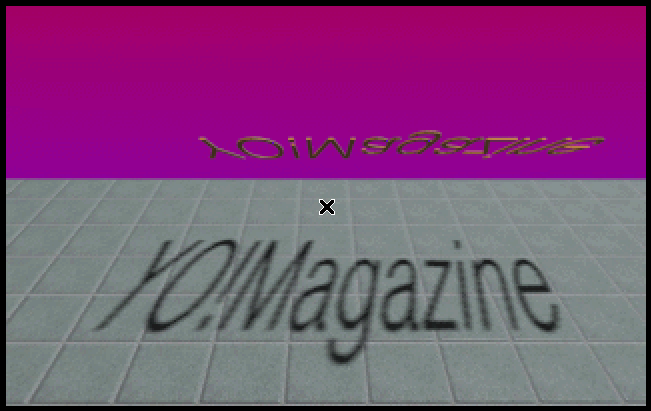
Issue #1 (November 1994) — the title screen, exactly as it boots above.Joint-Issue #2 & #3 (February 1995) — a Valentine's special, released two days before Valentine's Day.
A magazine that was a program
YO!Magazine (非常電子雜誌) was the house magazine of Yo!Net, the Hong Kong FidoNet-style BBS network.
It travelled the same way everything travelled then: as a file, passed board to board, downloaded over
modems. Open it and you got a full-screen colour reader — editorials, a technical column, a leisure
column, love stories, network notes and readers' letters — with GIF pictures up to 1024×768, bookmarks,
printer output and an author card for every writer.
It was programmed by Tom Ever and Leung Chun Ting — the same two names
at the top of the Yo!Net nodelist, the network's own coordinators. Issue #1 is dated 2 November 1994.
The second release, on 12 February 1995, merged Issues #2 and #3 into one — and dressed itself as a
Valentine's special, giant pink heart and all. Anyone who has shipped to a deadline will recognise what
happened: the February issue and the March issue became one issue, two days before Valentine's Day.
The only copy we can find
These two packages survived because one reader kept the original release ZIPs for thirty years.
That they are the genuine files is not a matter of trust: the publishers printed CRC32 checksums of the
executables and data files inside the packages themselves, and the files still match those 1994/1995
values exactly — bit-identical to release day.
In November 2026 we went looking for another copy: web searches, the Internet Archive's catalogue,
and DiscMaster's deep index of some 1.76 billion files from the era's CDs and shareware archives.
Nothing. As far as can be checked, the set on this page is the only surviving complete copy of
YO!Magazine — which is why it runs here, on the keeper's own site, rather than depending on anyone
else's link.
What I wrote in it
I was one of the magazine's editors — the "Editor's Word" column in both issues is mine — and one of
its regular writers. Issue #1 carries my Internet 簡介 (一), a piece on 28.8k V.34 modems, an
explainer of Internet e-mail service for BBS users, and YO!Net 與采妮. The joint issue carries
the sequel 淺談 Internet (二), a piece on Leon Lai (黎明與火舞艷陽), a co-written column on
the technique of dating (約會女性的技術, with Gund Bear) — and the piece that matters most to this
chapter:
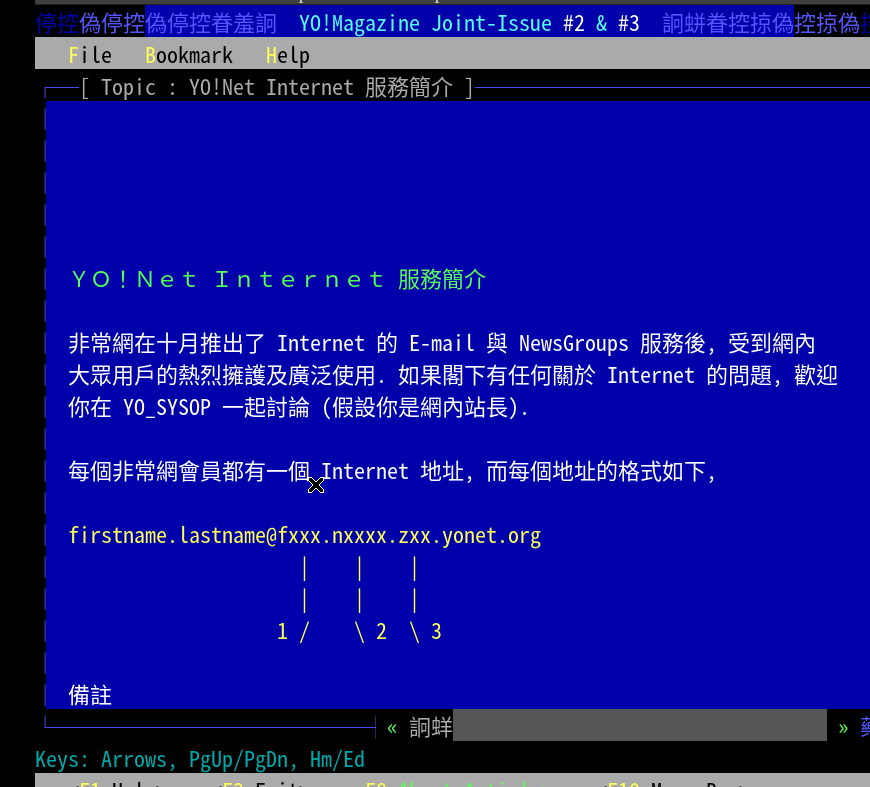
《YO!Net Internet 服務簡介》 — my own article in Issue #2 & #3, announcing the network's Internet e-mail and newsgroup service and explaining the address format every member received.
YO!Net Internet 服務簡介 is the service documentation for the UUCP gateway described in
the BBS chapter — the hand-built bridge that carried the network's mail between
Hong Kong and Canada over university e-mail, three times a day, by hand. The joint issue's closing
"Thank YOU!!" page lists me as one of the magazine's Canada submission contacts: Albert Cheung,
albc@yonet.org, BBS 1-604-323-8417 — the Pasin Int'l BBS Mail Gateway line, in print.
Reading it in 2026 takes a 1994 machine
The magazine's Chinese is Big5, and a 1994 DOS machine could not show Big5 by itself — readers ran a
Chinese system, most famously ETen (倚天中文系統). So that is what is inside the frame
above: the original executables, unmodified, running in a DOSBox-X emulator in your browser, with a
period ETen Chinese System 3.53 loaded first — the same software stack a 1994 reader would have used.
Nothing is translated or re-typeset; what you see is the magazine rendering itself.
I knew that system well. Before I ever left Hong Kong I was playing with ETen in Primary 6 — I thought
the DynaLab character-card fonts were beautiful — and at ten-something I was my father's company's
resident ETen and SCSI expert, the kid in meetings with the vendors. If you want to feel the machine
itself, the third button above boots the full ETen 3.53 to a bare DOS prompt: type DIR, look
around, run YOMAG01 yourself.