A period-style station card. The original ANSI welcome screens went down with the drive in 1996 — this one is redrawn from the nodelist record, in tribute.
1992 — a terminal program and a fax machine
The first modem I ever owned was, I believe, a Cardinal — 2,400 bps. Then I saved up and bought a Hayes at 9,600 — and later added a U.S. Robotics HST running at 16.8K: by then there were two lines, the first on the HST, the second on the Hayes. And my first BBS wasn't built with BBS software. I wrote it with the scripting code of Telix, a terminal program, and it wasn't
even for chatting: a Chinese software agent in Toronto used it to take orders online, and every order that came in, I faxed over
to him. Years before the web, it was a working prototype of e-commerce.
A university student, Eddy Wong, saw that prototype and came to talk. We teamed up, and it grew into Pasin BBS — more than
ten phone lines, running in Vancouver, node 1:153/717 on FidoNet.
I had only just arrived in Canada — Grade 9, a new country and a new language. School, honestly, got what was left of me.
Homework was done at a sprint the moment I got home — not out of diligence, but to clear the runway: dinner by six, and then
the BBS, straight through the night. Most nights I was up until four in the morning keeping it alive, slept two hours, and
went to class. The nodelist flags said CM — Continuous Mail. They never mentioned the operator.
The program itself still runs. This is Telix 3.20 — the 1993 shareware release, the same kind of
copy a teenager would have pulled down from a BBS like mine — alive in your browser:
Click the screen to give it your keyboard · Alt-D opens the dialing directory · Alt-Z lists every key
Telix 3.20 shareware (Exis Inc., 1993), preserved from a period shareware disk set. My first BBS was written in SALT, the
script language built into this program — its compiler, CS.EXE, is on the disk too. Leave with Alt-X and you are standing
at a 1993 DOS prompt. I learned SALT from the Telix reference manual — I read that book to pieces.
The bridge I built by hand
Across the Pacific was Yo!Net, one of Hong Kong's large FidoNet-style networks, where I served as a regional
coordinator. International calls were expensive, so I invented our transport: echomail, netmail — even BRE league data — packed
into email and carried between Hong Kong and Canada with the Pine mail reader. I was still in high school — the Hong Kong
account was Jennifer Lai's university account; on my side, I was already on Wimsey, one of Vancouver's first Internet
providers. Three times a day, I ran the exchange by hand. On the Hong Kong end, every night, was Jennifer Lai.
Killed by the era's technology
The setup had grown the way everything grew then — one hack at a time. It began on a single machine under DOS, multitasking
with DESQview. When the station expanded to three lines, the machines were linked with LANtastic. The SCSI drivers of that era were a chaotic mess, and what finally made the whole arrangement stable was a product called CorelSCSI. Once the HST was running at 16.8K, even the serial port's UART chip had to be swapped for a 16550A — without its 16-byte FIFO, high-speed transfers dropped characters faster than a file could finish. In the end there were more than
ten lines — and keeping them all talking to one another became the problem that finished us.
Pasin declined when we tried to centralise: ten-plus machines tied together with NetWare 3.11. NetWare had a fatal flaw for us —
its CD-ROM drives would unmount without warning, and each unmount could bring the whole network down. We never solved it.
Windows NT 3.5 was next, but its multitasking was too slow for a multi-line board. Pasin ended — not for lack of callers, but
because the technology of the day couldn't hold it up. I kept my own station going alone, on OS/2 3.0, under a new name:
Bear Bear Cafe. My copy of OS/2 had come from an outlet in the States, bought that autumn.
The night it went silent
In the winter of 1995–96 I moved house, and for the move I had to switch the machine off. A hard drive that has run non-stop
for years can refuse to ever spin up again — and mine didn't. I had backups: an Iomega drive, backed up every single night, and
every night it reported success. When the day came to restore, it restored nothing.
Every night it reported success. When the day came to restore, it restored nothing.
I wasn't alone in that. The failure had a name — the “Click of Death” — and it ended in a class action,
Rinaldi v. Iomega Corp. (filed 1998, settled 2001). But at the time, all my callers knew was that the station vanished.
Some thought I had simply run away. The truth is duller and sadder: the drive died, the backup was a lie, and a station that
size — its message bases, its users, its leagues, its place in two networks — existed only on that drive. There was nothing
left to rebuild from.
Thirty years later
Bear Bear Cafe is being rebuilt — on a Raspberry Pi, with its data on SSD, backed up every night to a NAS and regularly to
the cloud. Every failure that killed it in 1996 has been engineered out.
This time, the backups are verified.
1992Pasin Mainframe 9600 baud · HST
1993Pasin Int'l Gateway H16 · the bridge years
1994Bear Bear Cafe V.34 · 28,800
1995The move new number 267-0986
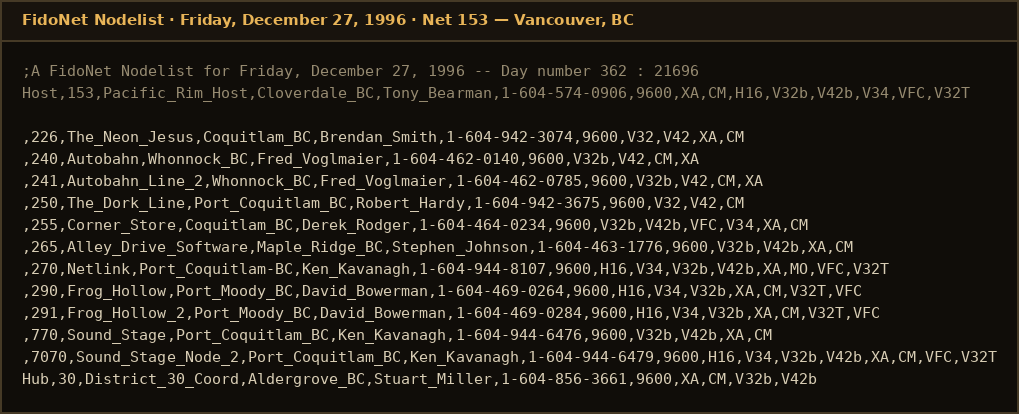
1996Silence — not listed —
Backstage — the station at night, running again
Callers saw menus, ANSI colour and door games. The sysop saw this. One program held the phone line all night —
BinkleyTerm, the mailer — but it decided nothing by itself. Whenever it exited, it left a number behind:
an errorlevel, and the station's batch file read the number and jumped. Compressed mail had arrived — exit
30, the E3 event exit — and the batch ran TosScan to toss the packets into their message
areas. A human being was a different number altogether: the caller's connect speed divided by a hundred — an HST caller
at 19,200 baud (the U.S. Robotics Courier — the flagship modem that was the sysop status symbol of the day) exited
at 192 — and
the batch loaded RemoteAccess — the BBS itself — where the
favourite door was BRE, Barren Realms Elite, the inter-BBS war game whose league packets crossed the
Pacific every night on the Yo!Net bridge.
The reconstruction above loops that night forever — two phone calls, two numbers, two roads. Tap the gold button
beneath the BinkleyTerm banner and a real handshake plays: a USRobotics Sportster negotiating an actual call —
answer tone, warble, bongs and all (recording from the Internet Archive's modem handshake collection, CC BY).
It is drawn from the real
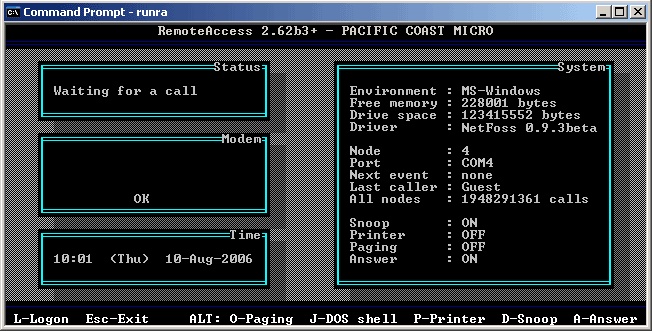
screens: BinkleyTerm's wall of yellow status boxes, and the RemoteAccess waiting-for-caller screen preserved in the
sysop's own files:
The genuine article — a RemoteAccess 2.62 waiting-for-caller screen of the era. The reconstruction follows it box for box: Status, Modem and Time down the left, the System panel on the right, and the sysop's command line along the bottom.
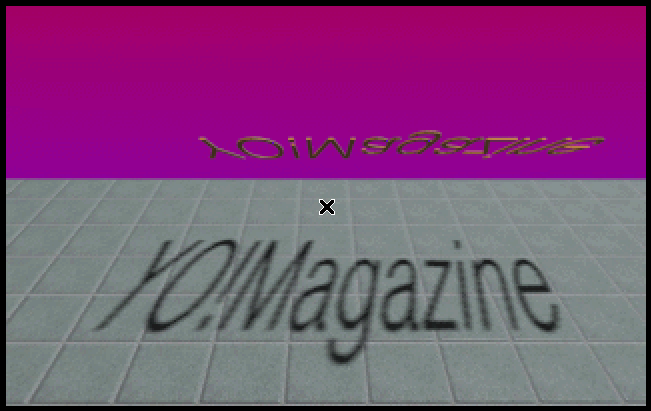
YO!Magazine — the network's own magazine, running again
Yo!Net also published its own electronic magazine — a DOS program, not a text file: colour
editorials in English and Chinese, pictures, bookmarks. I was one of its editors and a regular
writer, and its closing pages carried my name as a Canada contact. The two release packages
survived in my keeping for thirty years, checksums intact — and as far as we can find, they are
the only complete copy left. Both issues now run in your browser, on a period ETen Chinese
system, exactly as a 1994 reader would have opened them.
Almost everything else is gone, but one document survives: a Yo!Net nodelist, preserved in a
BBS directory archive. A full copy is
mirrored on this site, so the record stands even if that archive ever goes dark. Yo!Net ran as an “othernet” — Zone 7 for Asia,
Zone 10 for North America. If you ran one of these boards, or called one, this is the roll call. (Phone numbers omitted — those lines are long gone.)
Mickey Chan · Edmund Kam · Fatman Wong · Lapton Kwok · Andy Cheng
7:1010/47
MIDI STATION · Sham Shui Po
Jacky Yew
7:1010/81
Everlasting BBS II - WOW! · Kwai Chung
Jenni Lai
7:1010/85
The Mad Mage BBS · Tsim Sha Tsui
Mickey Chan
7:1010/86
Lapton Tea Hut · Kowloon
Lapton Kwok
7:1010/121
晶友熱線 Jam Line · Shatin
Simon Ku
7:1010/208
Hong Kong BBS Association · North Point
Roger Nie
7:1010/457
AnyWhere Board · Sheung Shui
Chris Tang
North America · Zone 10
10:10/0
YO!Net - North America · Etobicoke, Ontario
Louis Chong
10:10/7
YO!Gate - Asia · Burnaby, BC
Leslie Tam
10:10/10
YO!Net UUCP Gateway · Burnaby, BC
Leslie Tam
10:1111/0
YO!Net - Toronto · Mississauga, Ontario
Randy Macey
10:1111/2
YO!Net Toronto Assistant Coordinator · Markham, Ontario
Gary Tsang
10:1212/0
YO!Net - Vancouver · North Vancouver, BC
John Otsuka
10:1212/100
YO!Net Vancouver Hub 100 · Burnaby, BC
Leslie Tam
10:1212/300
YO!Net Vancouver Hub 300 · Vancouver, BC
Winson Tam
The Burnaby gateway — YO!Gate - Asia — was the Canadian landing point of the Hong Kong link: the far end of the bridge
described above. And one line is missing from this edition of the list: Pasin, and my own name. By the time this nodelist
circulated, the drive had already died. The list went on without us — which is, in its own way, the proof.
My Yo!Net addresses10:10/0 — North America coordination10:10/10 — the UUCP gateway itselfAs printed on the YO!Magazine author cards — 1994 first issue · 1995 joint issue
My addresses survive in print elsewhere. The author card in YO!Magazine — printed in the 1994 first issue and
again in the 1995 joint issue — gives my Yo!Net addresses as 10:10/0 and 10:10/10: the North America
coordination address, and the UUCP gateway itself. By the time the nodelist above circulated, both had passed to other hands.
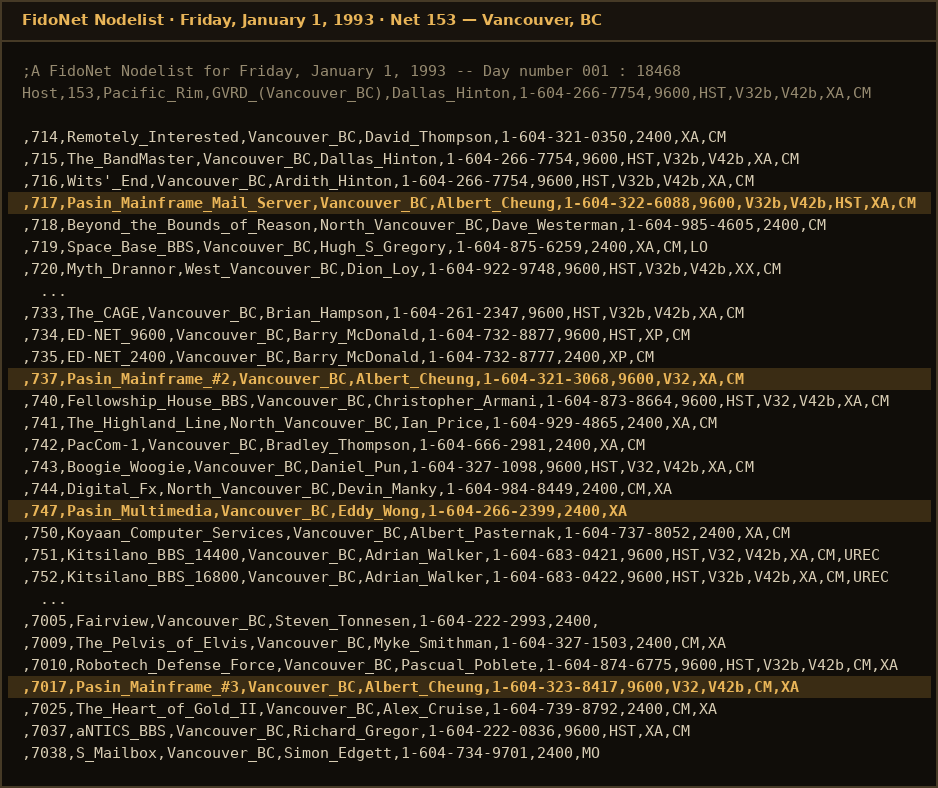
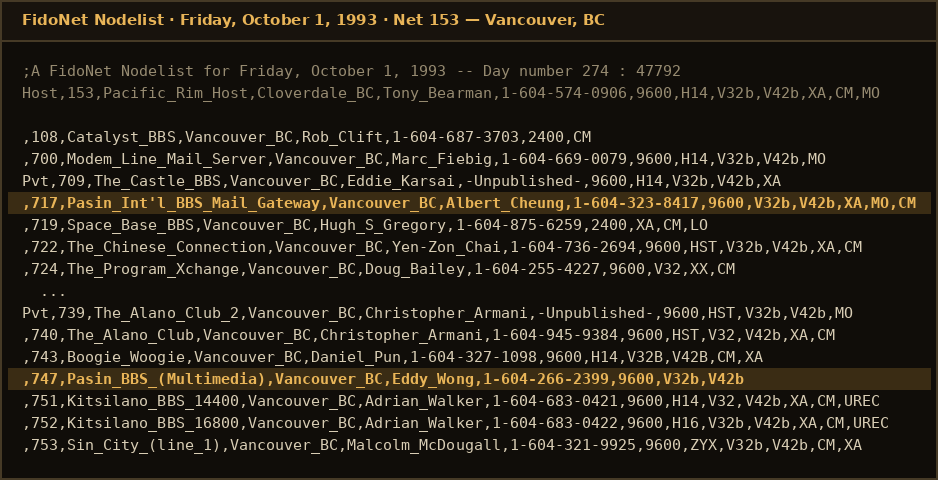
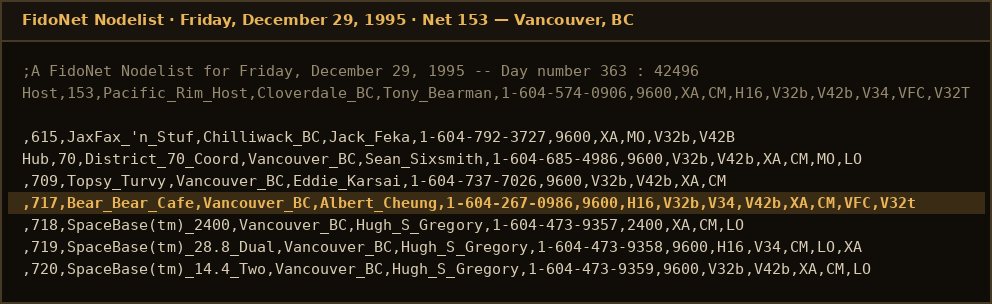
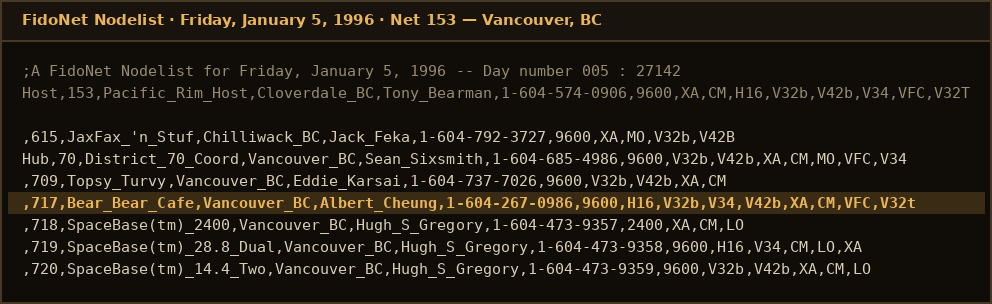
My FidoNet record — node 1:153/717, 1992–1996
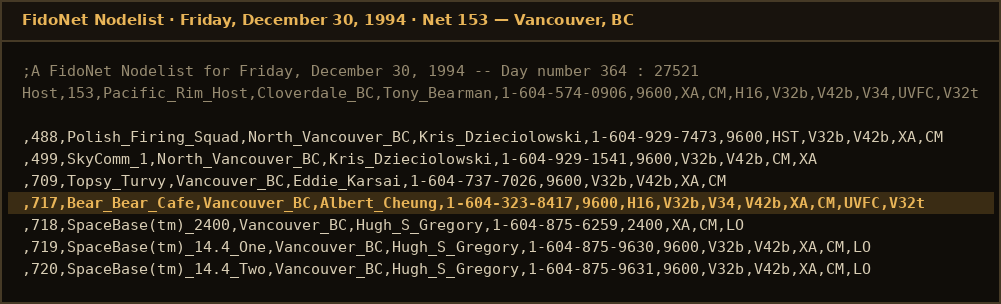
FidoNet published its nodelist — the network's master directory — every Friday, and the archive survives at
textfiles.com. These are my own entries, exactly as printed, year by year. Read them in sequence and they tell the whole
story by themselves: the name changes, the modem upgrades (9600 → H16 → V.34), the new phone number in 1995 — and then, at the end of 1996, silence.
— not listed. The drive had died that winter; the station never came back. —
The printed page itself — 30 Dec 1994, Net 153: node 717 becomes Bear Bear Cafe. The full set of pages is kept in the documents section below.
Source: the FidoNet nodelist archive at textfiles.com (nodelists of 1992–1996, Net 153, Vancouver BC).
The 1995 number change is the house move — the move that ended it.
The Vancouver BBS list — the local directory
FidoNet was the world; the 604 area-code list was the neighbourhood. The scene's own Vancouver directory — preserved in a
Forum Vancouver nostalgia thread, and mirrored here — lists every line we ran, under every
name they carried. Note what the FidoNet list alone doesn't show: the Peace & Silence lines, and a Pasin BBS
line (266-2859) that only ever lived in the local list.
There was a small war behind this list. The mainstream Vancouver list of the day was Roxanne Spear's — the name
rings a bell; it was very likely her. Her list ran around her own circle, and our ten lines were not welcome in it.
So I made my own: a month of work, Vancouver and Victoria both, published every month without fail, and I kept it up
for years. For a while the scene had two public lists — hers, and mine. Mine drove her mad. The copy of her list that
survives is one of her last editions — by then, our lines were in it.
604-322-6088
Pasin Mainframe Mail Server · Peace & Silence! · Peace and Silence 1 · 1992–1994
Albert Cheung
604-321-3068
Pasin Mainframe #2 · Peace & Silence! · Peace and Silence 2 · Peace and Silence 3 · 1992–1994
Pasin BBS (Multimedia) · Peace and Silence 2 · Peace and Silence 3 · 1992–1993
Eddy Wong
604-266-2859
Pasin BBS · 1994
604-267-0986
Bear Bear Cafe · 1995–1996
Albert Cheung
The documents — nodelist pages, kept here
Links rot and archives vanish — this station was already lost once to somebody else's storage. So the evidence does not
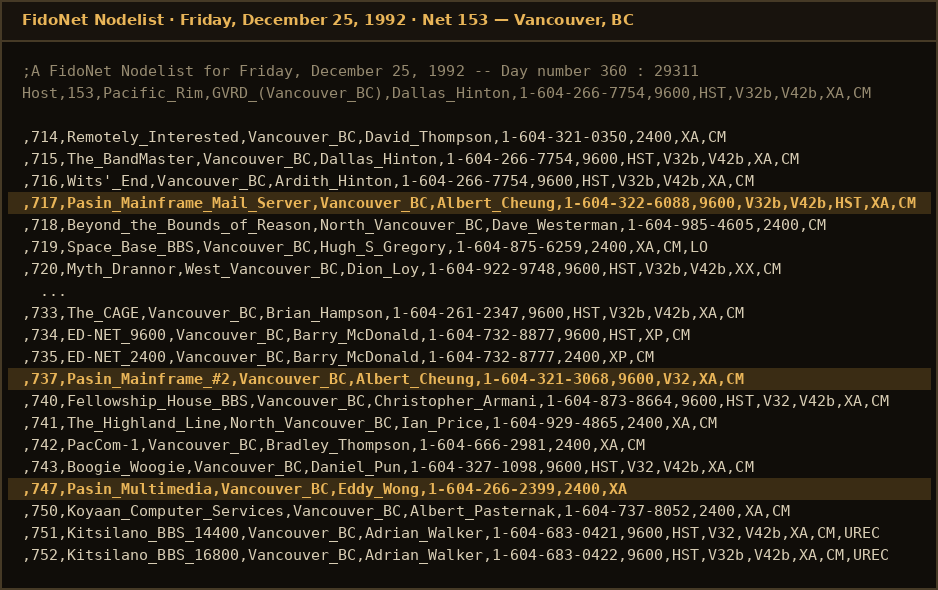
live on a link: the pages below are kept on this site, rendered line-for-line from the archived nodelist files
(preserved with SHA-256 checksums), my lines highlighted in gold. Each exhibit links to its verbatim text excerpt.
25 Dec 1992 — Pasin Mainframe Mail Server, Mainframe #2 and Pasin Multimedia, in print. Text excerpt1 Jan 1993 — a third Mainframe line joins the list (node 7017). Text excerpt1 Oct 1993 — renamed Pasin Int'l BBS Mail Gateway: the bridge years. Text excerpt30 Dec 1994 — node 717 is now Bear Bear Cafe, with a V.34 modem. Text excerpt29 Dec 1995 — Bear Bear Cafe on its new number, 267-0986: the house move. Text excerpt5 Jan 1996 — the last listing. Text excerpt27 Dec 1996 — the Vancouver list jumps from node 291 straight to 770. No 717. Gone. Text excerpt